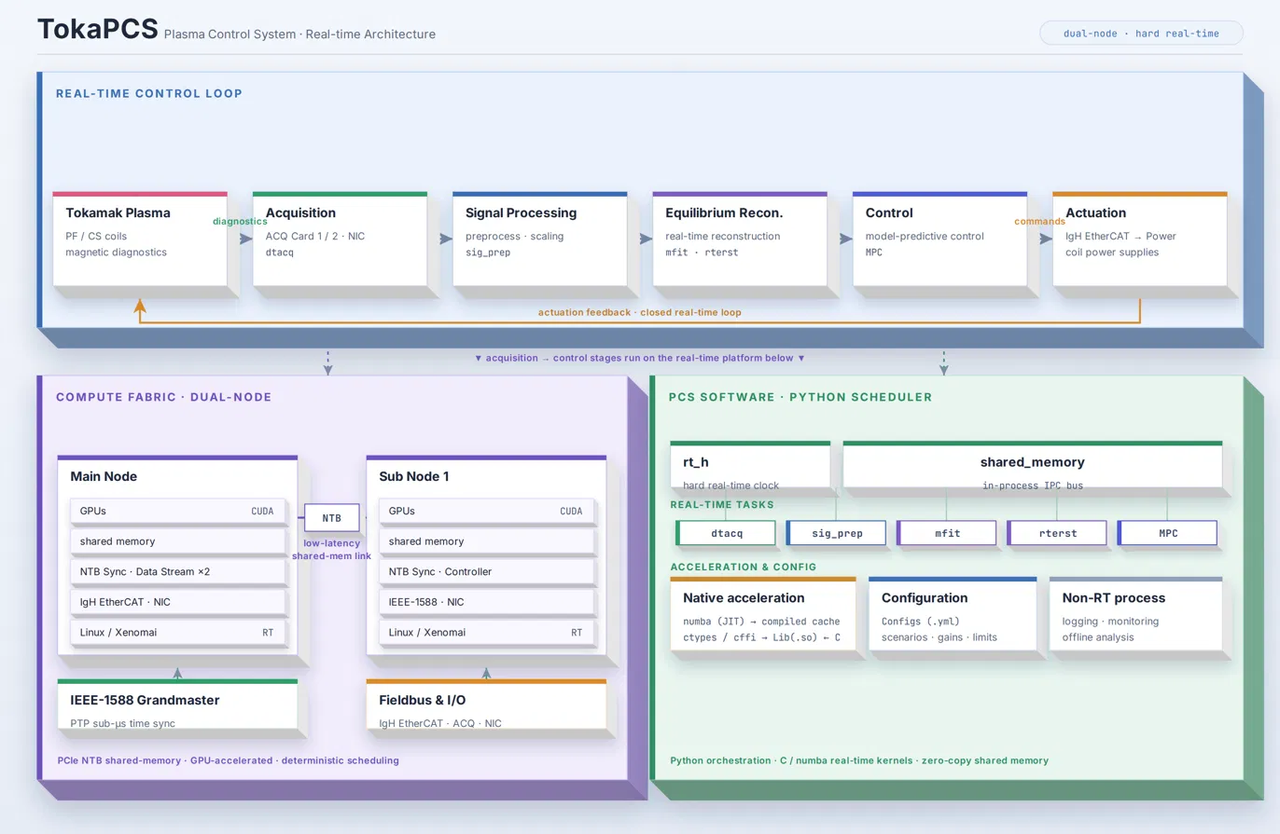
TokaPCS
TokaPCS (Tokamak Plasma Control System) is a fully self-developed plasma control system by Startorus Fusion. Its hardware is built on x86 servers and low-latency PCIe NTB interconnect technology, combined with EtherCAT (Industrial Ethernet Fieldbus), to achieve a deterministic 10-kHz control cycle. The software adopts a dual-kernel real-time architecture based on Linux and Xenomai, together with a Python development framework. This design addresses the jitter issues encountered by general-purpose computing platforms in hard real-time control, enabling the control system to combine high real-time performance with versatility. At present, a range of control algorithms—including RZIp_SISO, RZIp_LQR, RZIp_LQG, RZIp_MPC, iso-flux_SISO, physics-based and data-driven reinforcement learning (RL), and density-feedback control—as well as real-time observation algorithms such as RT-ERST and magnetic reconstruction with eddy-current estimation, have been deployed on the TokaPCS hardware and software framework. A series of feedback-control experiments has also been conducted.

TokaPCS

TokaPCS (Tokamak Plasma Control System) is a fully self-developed plasma control system by Startorus Fusion. Its hardware is built on x86 servers and low-latency PCIe NTB interconnect technology, combined with EtherCAT (Industrial Ethernet Fieldbus), to achieve a deterministic 10-kHz control cycle. The software adopts a dual-kernel real-time architecture based on Linux and Xenomai, together with a Python development framework. This design addresses the jitter issues encountered by general-purpose computing platforms in hard real-time control, enabling the control system to combine high real-time performance with versatility. At present, a range of control algorithms—including RZIp_SISO, RZIp_LQR, RZIp_LQG, RZIp_MPC, iso-flux_SISO, physics-based and data-driven reinforcement learning (RL), and density-feedback control—as well as real-time observation algorithms such as RT-ERST and magnetic reconstruction with eddy-current estimation, have been deployed on the TokaPCS hardware and software framework. A series of feedback-control experiments has also been conducted.
TEMO
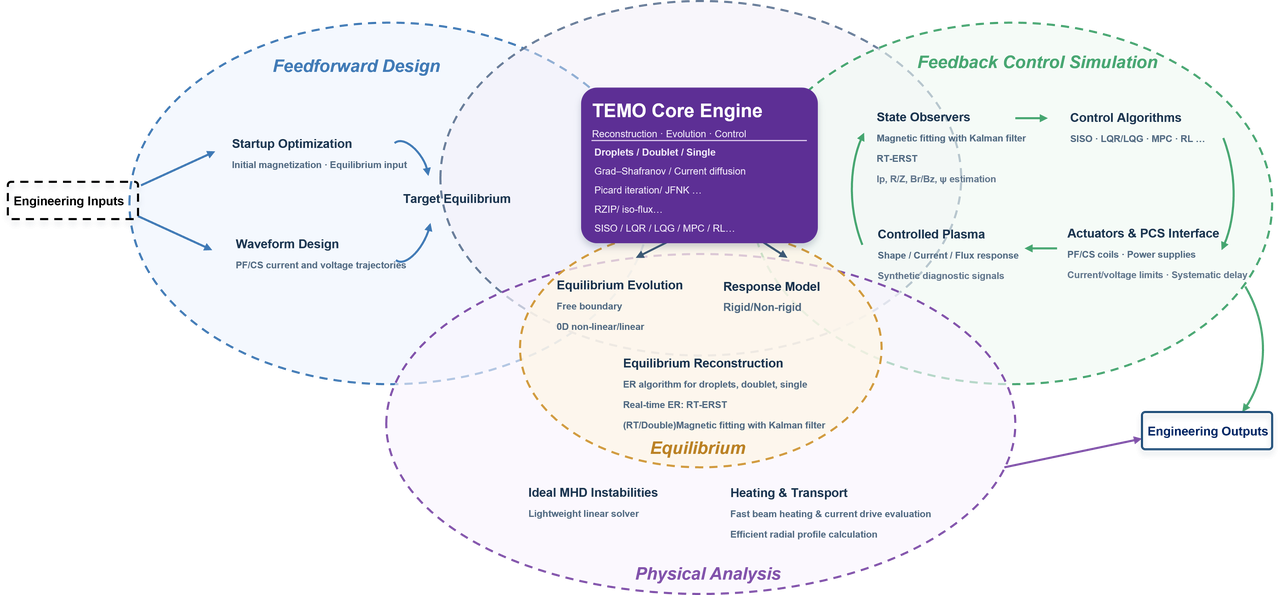
TEMO (Tokamak Equilibrium Modeling toolbox for Operation) is an operation-oriented tokamak equilibrium toolbox that covers the entire experimental workflow, from discharge design to analysis. It supports full closed-loop simulation of the evolution, observation, and control of both singlet/doublet configurations, providing strong support for discharge design, controller design, diagnostic data processing and physics experiment analysis during experimental operations.

TEMO

TEMO (Tokamak Equilibrium Modeling toolbox for Operation) is an operation-oriented tokamak equilibrium toolbox that covers the entire experimental workflow, from discharge design to analysis. It supports full closed-loop simulation of the evolution, observation, and control of both singlet/doublet configurations, providing strong support for discharge design, controller design, diagnostic data processing and physics experiment analysis during experimental operations.
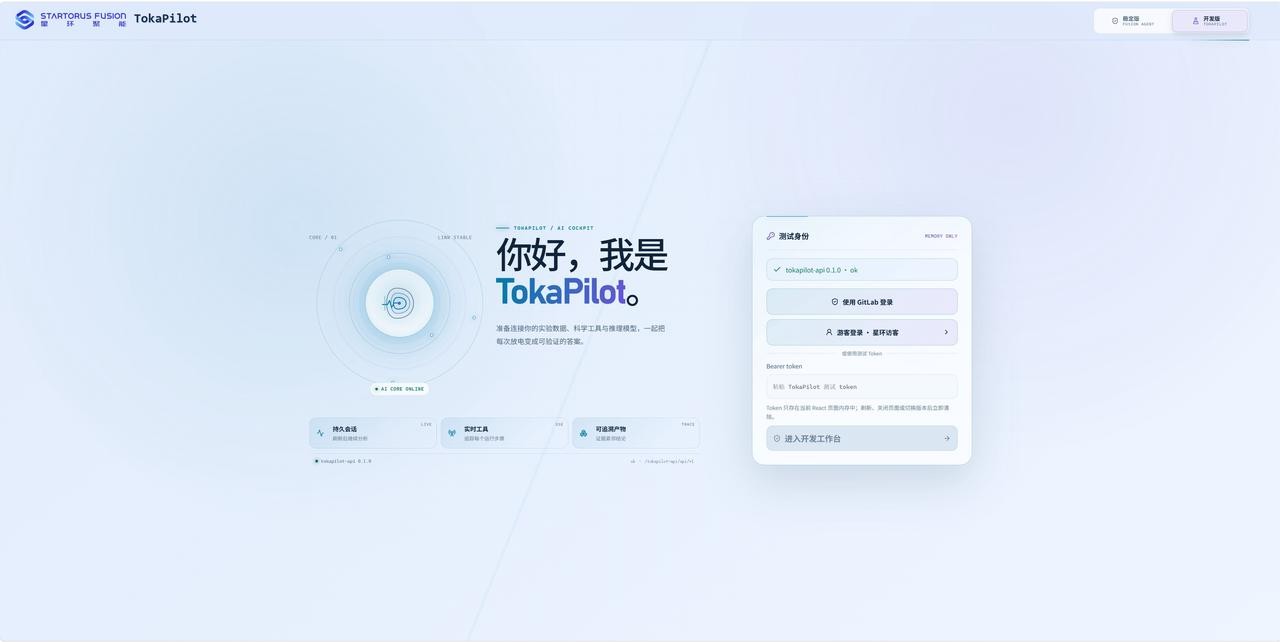
TokaPilot
Built for SUNIST-2 experiment analysis, TokaPilot brings experimental data, analysis programs, diagnostic tools, and shared knowledge into a single entry point. Researchers use natural language to query shots, retrieve data, plot, analyze, summarize, and review anomalies.Hand repetitive data retrieval, script hunting, and figure stitching to the system—people only verify results and make physics judgments. Single-shot waveforms, discharge summaries, threshold adjustment, and anomaly detection can all be delegated to it, with results returned as plots, tables, and reports. Web and Feishu data stay in sync, so you can start an analysis anytime.

TokaPilot

Built for SUNIST-2 experiment analysis, TokaPilot brings experimental data, analysis programs, diagnostic tools, and shared knowledge into a single entry point. Researchers use natural language to query shots, retrieve data, plot, analyze, summarize, and review anomalies.Hand repetitive data retrieval, script hunting, and figure stitching to the system—people only verify results and make physics judgments. Single-shot waveforms, discharge summaries, threshold adjustment, and anomaly detection can all be delegated to it, with results returned as plots, tables, and reports. Web and Feishu data stay in sync, so you can start an analysis anytime.
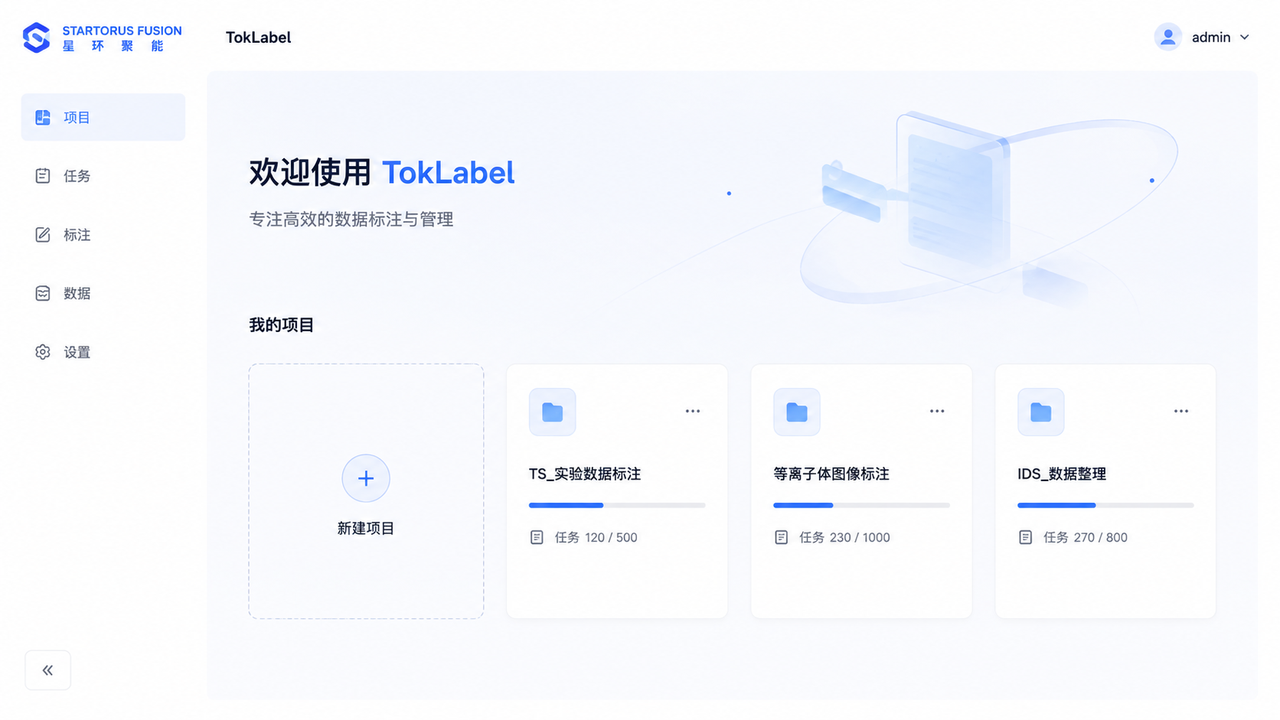
TokLabel
TokLabel (Tokamak Label Suite) is an open-source fusion data labeling platform co-developed by Startorus Fusion and Tsinghua University, built on the open-source Label Studio and released under the Apache 2.0 license. Fusion AI researchers spend roughly 70% of their time on data preparation, and TokLabel targets exactly this stage.It turns raw discharge data into labeled datasets ready for fusion AI. Researchers simply input a shot number to automatically retrieve data and generate labeling tasks — labeling feature moments such as breakdown, disruption, and end on one-dimensional time series, and configuration information such as the last closed flux surface on two-dimensional visible-light images. Labeling results are stored by shot number and directly consumed by downstream model training such as disruption prediction, discharge feature recognition, and configuration recognition, saving roughly 70% of data-preparation time.

TokLabel

TokLabel (Tokamak Label Suite) is an open-source fusion data labeling platform co-developed by Startorus Fusion and Tsinghua University, built on the open-source Label Studio and released under the Apache 2.0 license. Fusion AI researchers spend roughly 70% of their time on data preparation, and TokLabel targets exactly this stage.It turns raw discharge data into labeled datasets ready for fusion AI. Researchers simply input a shot number to automatically retrieve data and generate labeling tasks — labeling feature moments such as breakdown, disruption, and end on one-dimensional time series, and configuration information such as the last closed flux surface on two-dimensional visible-light images. Labeling results are stored by shot number and directly consumed by downstream model training such as disruption prediction, discharge feature recognition, and configuration recognition, saving roughly 70% of data-preparation time.
Contact Us
Tel: 029-86041002
Email: business@startorus.cn
Company Address
Address: 
Room JT109869, 2nd Floor, Building 39,52 Chengliu Highway,Jiading District, Shanghai,China
Address: 
2-22,Northern Intelligent Manufacturing Park,Gaoling District, Xi'an,Shaanxi Province, China.
Follow Us
Scan The QR Code To Follow Our WeChat Service Account